
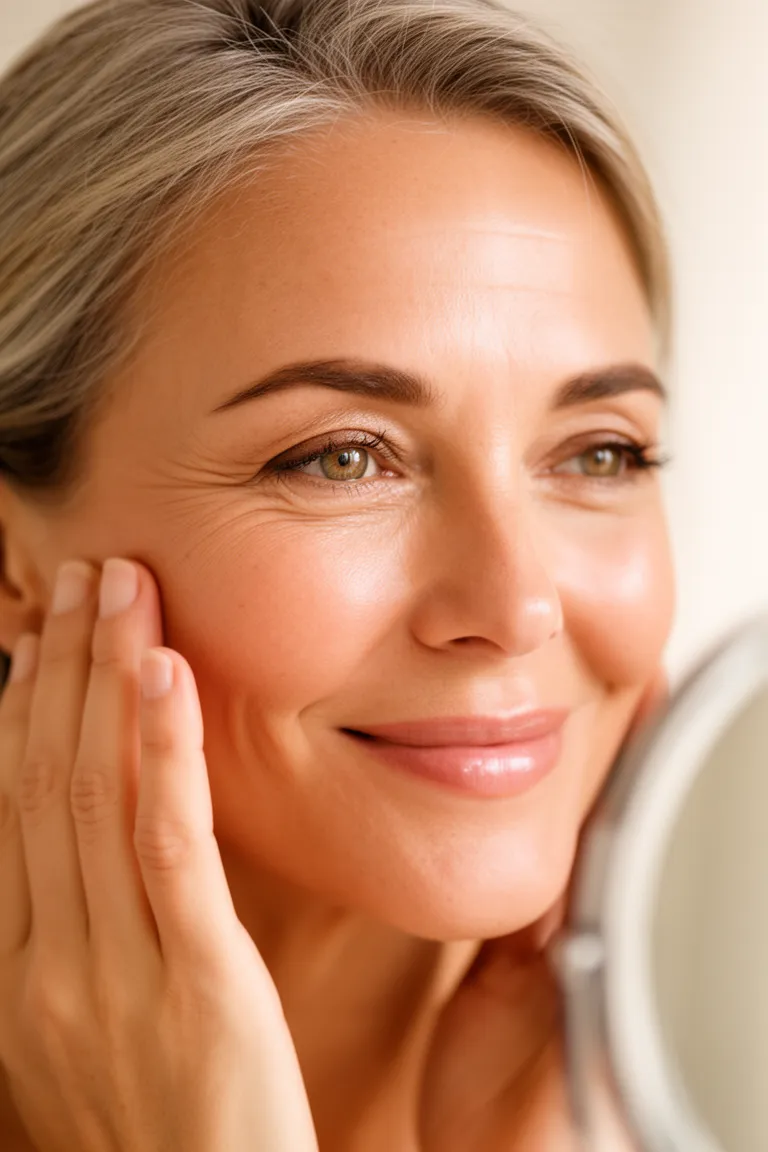
It was a Tuesday morning, and I was trying to take a decent selfie for my daughter’s birthday post. I tilted my head, smiled, and there it was—not a wrinkle, exactly, but a softness around my jawline that refused to snap back. It was a gentle sag, a subtle looseness I’d never seen before. I was 47. I ran three times a week, ate my greens, and prided myself on being the friend who always had sunscreen in her bag. Yet, in that unforgiving phone camera square, my skin looked… thinner. Less like my skin. A quiet panic set in. Wasn’t I doing everything right?
That moment kicked off a two-year, often-frustrating quest to restore skin elasticity after 40. I dove headfirst into the world of luxury creams, collagen peptides I mixed into my morning coffee, jade rollers, and serums that cost more than my electric bill. I’d get a fleeting plumpness, a temporary glow, but that underlying resilience, the firmness I remembered, felt like it was slipping through my fingers. I became deeply skeptical, scrolling through before-and-afters wondering, “Is it just good lighting?” I felt like I was following all the rules but failing the test.
The turning point wasn’t a miracle product. It was a shift in understanding. I finally learned that restoring skin elasticity after 40 isn’t about finding one hero ingredient. It’s about repairing the foundation, playing the long game, and realizing that what worked at 35 can actively work against you at 47. This is the story of my mistakes, my discoveries, and the simple, consistent routine that finally made a real difference.
The Morning I Realized My Skin Elasticity Had Changed After 40
That selfie wasn't my first clue, but it was the one that stuck. The signs had been creeping in for a while, but I’d been expertly explaining them away. I’d notice it when I applied foundation; my skin seemed to “drink” it differently, settling into areas that once were smooth. I saw it in candid photos where my smile seemed to linger on my cheeks a beat too long, like an echo of the expression. This wasn’t about fine lines or dryness, which I could tackle with a richer moisturizer. This was about laxity—a loss of the structural bounce-back that defines youthful skin. It felt deeply unfair. I’d invested time and money into my health and my skin, and here was a change that seemed indifferent to my efforts. It made me question everything I thought I knew about skincare.
The difference between dehydration and true laxity. In my initial panic, I mistook the two. Dehydrated skin looks crepey, feels tight, and bounces back quickly once you hydrate it. The loss of elasticity I was seeing was different. When I gently pinched the skin on my cheek, it took longer to flatten back out. It wasn’t thirsty; it was architecturally changing. This is the moment I think many of us hit: when we realize our skincare goals need to shift from surface-level perfection to deeper structural support.
Why My Healthy Lifestyle Was Not Enough to Restore Skin Elasticity
I had to confront a hard truth: my good habits were fantastic for my overall health, but they were primarily playing defense against a natural, internal clock. I was so frustrated, wondering why is my skin losing elasticity after 40 despite using sunscreen and eating well? The answer was a multi-layered reality check.
First, there’s the simple math of biology. Around our mid-20s, collagen production begins a slow decline. By 40, research suggests we’re losing about 1% of our collagen each year. Elastin fibers, the ones that allow skin to snap back like a new rubber band, begin to degrade and fray. This is a built-in process; no amount of kale smoothies stops it entirely. They can slow it, but not halt it. Functional integrity of aging skin, from cutaneous biology to anti-aging...
Then, I had to get honest about “most days” sunscreen. Cumulative UVA exposure is a silent thief. These rays penetrate deep into the dermis, breaking down collagen and elastin like slow-acting scissors. Even the walks I took without reapplying SPF were adding to a lifetime of photoaging. My healthy lifestyle was mitigating the damage, but it wasn’t reversing decades of subtle sun exposure.
Finally, the hormonal shift I wasn’t prepared for: perimenopause. The fluctuating estrogen levels of my late 40s directly impact collagen production and skin thickness. It’s like the internal scaffolding that kept everything plump and firm started to get periodic memos to downsize. My skin barrier was also becoming more fragile with these shifts, meaning even the good ingredients I used weren’t being held in as effectively. My body was changing the rules of the game, and I was still playing by the old playbook.
The Skincare Mistakes I Made While Chasing Firmer Skin
In my panic to restore what I felt I was losing, I made every classic error. This phase was expensive, frustrating, and ultimately, my greatest teacher. If you’ve ever felt like you’re wasting money on products for skin elasticity after 40, you’re not alone. I was right there with you. am I wasting money on anti wrinkle cream or should I just see a dermatologist.
Mistake 1: The “More Is More” Active Ingredient Assault. Convinced that more firepower meant faster results, I layered retinoids, potent vitamin C, exfoliating acids, and peptide serums, sometimes all in one night. My logic was flawed. I just inflamed my skin, severely compromising my barrier. The result wasn’t firmness; it was redness, sensitivity, and a crepey texture that made any laxity look worse. I was trying to rebuild a house while simultaneously taking a sledgehammer to the walls.
Mistake 2: Confusing Hydration for Elasticity. I fell hard for the “plumping” trap. I’d buy a moisturizer bursting with hyaluronic acid, see my skin look dewy and full for a few hours, and think I’d solved it. But hydration is temporary. It’s like plumping a pillow with air. Once the water evaporated, the underlying structure—the pillow’s filling—was still flat. I was mistaking a temporary cosmetic effect for the deeper structural change I needed.
Mistake 3: Impatience and Inconsistency. I’d read that a product took 12 weeks to work, but by week 4, if I didn’t see a transformation, I’d switch to something new. I never gave anything time to work on a cellular level. The most damaging inconsistency, however, was with sunscreen. A dab in the morning didn’t protect me during my lunchtime walk or school run. I was trying to build new collagen while, some days, still allowing the UV rays that break it down to have access.
What I Learned About Collagen, Peptides, and Retinol
This is where my journey got interesting, and where I think a lot of marketing glosses over the hard truths. After my phase of mistakes, I stepped back to understand the how behind the hype.
Let’s talk about collagen supplements. I spent a small fortune on powders and drinks. While they might support joint health, the science on them directly rebuilding your facial collagen is nuanced. The molecules are broken down in digestion, and there’s no GPS that directs them to your cheeks. Some promising studies show improvements in skin hydration and density, but expecting them to single-handedly lift a jawline felt, in my experience, like an expensive gamble. They could be a supportive player, but not the star quarterback of my routine.
Peptides were another learning curve. These are signaling molecules that can tell your skin to produce more collagen. The key word is can. They are gentle, slow, and subtle workers. They’re fantastic for maintenance, support, and communicating with your skin’s repair mechanisms. But I’d been sold them as quick fixes. Expecting a peptide serum to significantly reverse laxity on its own led directly to my disappointment. They work best as part of a choir, not as a soloist.
Then, retinol. Oh, retinol. I’d used it for years for fine lines, but I was using it all wrong for elasticity. I’d apply it, get dry and flaky, back off for a week, and never build a tolerance. I learned that retinoids work by accelerating skin cell turnover and, crucially, by signaling the fibroblasts deep in your dermis to produce new collagen and elastin. This is a construction project, not a paint job. It requires a consistent, gentle presence to keep sending those signals. This isn’t a 4-week process. It’s a 4-to-6-month commitment of careful, consistent use. Why wasn't my retinol helping skin elasticity after 40? Because I wasn’t using it correctly or patiently enough for it to do its deep, structural work.
The Missing Piece: Why Skin Barrier Repair Changed Everything
My true “aha!” moment didn’t come from adding another active. It came from stripping almost everything away. After a particularly bad bout of irritation from my over-zealous routine, a dermatologist friend told me to do a “barrier rehab” for two weeks: just a gentle cleanser, a ceramide-rich moisturizer, and a mineral sunscreen.
As the redness and stinging subsided, something else happened. My skin looked calmer, yes, but also… plumper, more even, and somehow more substantial. Here’s what I finally understood: Without a strong, intact lipid barrier, your skin loses water rapidly (trans-epidermal water loss). This chronic, low-level dehydration can make skin look deflated, emphasizing every bit of laxity. Think of a grape versus a raisin.
More importantly, a compromised barrier is like a broken city gate. It lets irritants in and vital moisture out, and it’s incapable of managing the controlled, constructive inflammation that actives like retinol need to do their regenerative work safely. I was trying to instruct my skin to build new collagen while its communication system was down and its building site was under siege. All the collagen-boosting ingredients in the world are less effective if your skin’s security system is broken. Repairing my barrier wasn’t just soothing—it was the foundational step that made every other step finally possible.
Scientific Evidence
What Actually Helped—and How Long Skin Elasticity Improvements Took
Armed with this new philosophy of “foundation first,” I rebuilt my routine with patience and strategy. This is what actually works for loose skin and loss of elasticity after 40, from my experience.
1. Sun Protection Became Non-Negotiable. The single most effective change was becoming religious about broad-spectrum SPF 30+, applied generously every single morning and reapplied if I spent more than 2 hours outside. This stopped the ongoing demolition. It’s the ultimate “protect what you have” move.
2. Barrier-First Hydration. Every morning and night, I used a moisturizer with ceramides, cholesterol, and niacinamide. This wasn’t just moisturizing; it was actively fortifying my skin’s architecture, brick by lipid brick.
3. The Slow, Steady Reintroduction of Actives. Only after a month of barrier care did I slowly reintroduce a retinoid. I started with a low concentration over my moisturizer (a technique called “buffering”) twice a week. I gradually increased frequency as my skin tolerated it, never pushing through redness. In the mornings, I added a stable vitamin C serum for antioxidant protection and to support collagen synthesis. skinception review before and after.
The timeline was the most humbling—and honest—part of the journey. This is the realistic answer to how long does it take to improve skin elasticity after 40?
- 4-8 Weeks: I saw improved hydration, brightness, and a more even tone. My skin just looked healthier.
- 3-4 Months: Subtle firming and improved texture became apparent. The skin around my cheeks and eyes felt denser to the touch.
- 6 Months to a Year: This is when the real change in resilience and elasticity became clear to me. The “snap-back” improved. The gentle sag along my jawline was less pronounced. It wasn’t a reversal, but a definite, tangible improvement.
This is the part no one wants to hear, but it’s the truth: you are planting seeds for a harvest next season. Consistency over months, not intensity over weeks, is what yields results.
| Approach | Best For | Realistic Timeline for Visible Change | Key Consideration |
|---|---|---|---|
| Barrier Repair & Sun Protection Only | Starting fresh, sensitive skin, or recovering from irritation | 4–8 weeks for improved hydration and calmness | Does not actively rebuild collagen, but creates the essential foundation for everything else. |
| Barrier Care + One Active (e.g., Retinol or Vitamin C) | Those new to actives or wanting a simple, focused routine | 3–4 months for texture and early firming | Slow and steady wins the race. Building tolerance is crucial to see long-term benefits. |
| Barrier Care + Combined Actives (e.g., Retinol, Vitamin C, Peptides) | Experienced users with resilient skin seeking multi-targeted support | 6+ months for noticeable improvements in elasticity | Requires careful layering and listening to your skin to avoid overload. Patience is non-negotiable. |
| Topical Routine + Professional Treatments | Addressing significant laxity where topical products have limits | Varies by treatment; often 1-3 months post-procedure for collagen remodeling | An investment in time and money. Topical care remains essential for maintaining results. |
My Simple Skin-Elasticity Routine After 40
This is the manageable, non-stressful flow I follow now. It’s not about a million steps; it’s about strategic, consistent ones. This is the best routine to restore skin elasticity after 40 that I’ve found—because I can actually stick to it.
Morning: Protect and Fortify. My goal is defense and nourishment. I splash my face with lukewarm water or use a milky, non-foaming cleanser. While my skin is still damp, I apply a vitamin C serum. I follow with my barrier-repair moisturizer packed with ceramides. Finally, I always finish with a generous amount of mineral sunscreen. This sequence is my daily armor.
Evening: Cleanse and Renew. This is for repair. I double-cleanse to thoroughly remove sunscreen and the day: first with a gentle balm or oil, then with a mild foaming wash. On Sunday, Tuesday, Thursday, and Saturday nights, I apply my retinoid serum. I wait about 10 minutes for it to settle, then layer my thicker, ceramide-packed night cream over it. On the other nights, I give my skin a break with just a hydrating serum and the same nourishing night cream. Once a week, if my skin feels robust, I might use a gentle exfoliating acid, but I’ve learned this is optional, not mandatory.
The beauty of this framework is its flexibility. If my skin feels sensitive or I’m tired, I skip the retinoid and just moisturize. I track progress not daily in the mirror, but by taking a simple selfie in the same neutral light every 8 weeks. The differences are subtle, but over time, they add up to the change I was searching for.
When to Consider Professional Help for Skin Elasticity
I also learned to have realistic expectations about what topical products can and cannot achieve. For the more significant laxity along my jawline—my personal nemesis—topical skincare has its limits. After a solid year of diligent home care, I consulted a dermatologist about professional options. probiotic for mood support.
She explained that treatments like radiofrequency microneedling, ultrasound (like Ultherapy), or certain lasers work by creating controlled, deeper injury in the dermis to stimulate a robust, wound-healing collagen and elastin remodeling response from within. These are investments, with real cost and sometimes downtime, but they target the structural issue more directly than any serum can.
For me, understanding this hierarchy was liberating. It took the immense pressure off my serum bottles to perform miracles. My daily routine became about consistent maintenance, improvement, and protection. For more advanced concerns, there were effective professional tools. This perspective made the journey feel collaborative and hopeful, rather than a desperate solo mission.
Frequently Asked Questions

Q: How long does it really take to see improvement in skin elasticity after 40? A: You have to shift your mindset from weeks to seasons. While better hydration and brightness can appear in 4-8 weeks, true improvements in firmness and elasticity from ingredients like retinoids that remodel collagen take a minimum of 3-4 months to become subtly visible, and often 6-12 months for more noticeable results. Consistency is everything. It’s a marathon, not a sprint.
Q: Why isn't my retinol helping my skin elasticity after 40? A: There are a few common reasons. You might not be using it consistently enough (skipping nights due to irritation breaks the signaling cycle). You may not be using a high enough concentration for your skin’s tolerance (though more isn’t always better). Or—and this was my big issue—you might be using it on a compromised skin barrier, which hampers its effectiveness and causes irritation that forces you to stop. Try “buffering” it by applying moisturizer first, and build frequency painfully slowly, like once a week for a month, then twice a week.
Q: Am I wasting money on collagen supplements for skin elasticity? A: The science is still evolving. Some studies show benefits for skin hydration and density, but the evidence for them directly rebuilding facial collagen and reversing laxity is not as strong or direct as the evidence for topical retinoids or professional procedures. In my experience, think of them as a possible supportive player in your overall health, not the star of your skincare team. Your money might be better first invested in a high-quality sunscreen and a proven topical active.
Q: What should I look for in products aimed at restoring elasticity? A: Focus on the ingredient deck, not the marketing claims. For your daily foundation, prioritize a gentle cleanser, a moisturizer with barrier-supporting ingredients like ceramides, fatty acids, and niacinamide, and a high-quality, broad-spectrum sunscreen. For active treatments, look for proven ingredients like retinol (or prescription retinoids like tretinoin), stabilized vitamin C (L-ascorbic acid or derivatives like ethylated ascorbic acid), and peptides like Matrixyl. Choose formulas from brands that disclose concentrations and avoid those loaded with fragrance or drying alcohol if you have sensitive skin.
Q: I eat healthy and exercise—why is my skin still losing elasticity? A: Please know you are not alone. This was the core of my frustration, too. Intrinsic aging (the yearly collagen decline) and the powerful hormonal shifts of perimenopause and menopause are independent factors. Your healthy habits are absolutely slowing the process, improving skin quality, and giving you a tremendous health advantage. But they cannot single-handedly stop these biological engines. It’s not a failure on your part; it’s a signal to adapt your external skincare strategy to work with your changing biology, not against it.
📌 Love this guide? Save it on Pinterest!
Pin Restore Skin Elasticity After 40: My Honest 2026 Journey & Routine to your board so you can come back to it later.

