
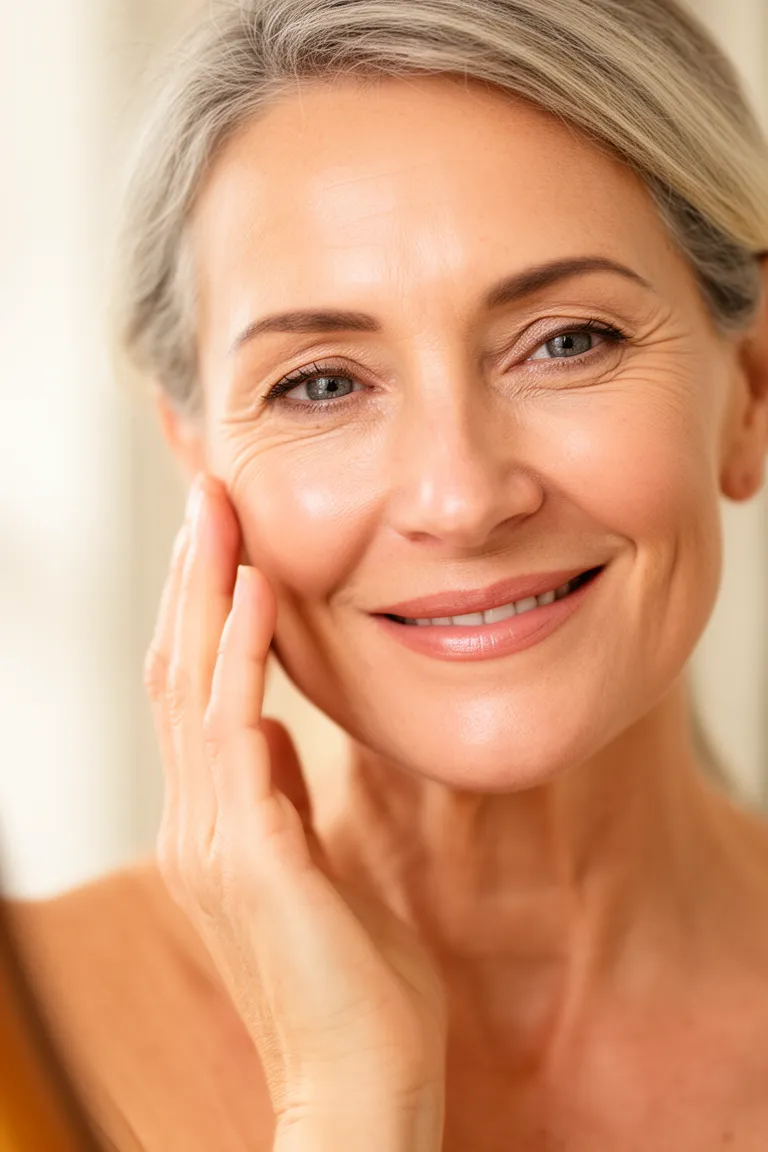
I was doing everything right. I mean, everything. My grocery cart was a rainbow of vegetables, my water bottle was a permanent accessory, and my daily SPF ritual was as sacred as brushing my teeth. At 47, I felt strong and healthy, but every morning, the mirror told a different story. I’d press a finger against my cheek and watch the skin slowly, reluctantly, creep back into place. The fine lines around my eyes seemed to have set up permanent residence overnight, and the defined jawline of my forties was starting to whisper about a future double chin. The disconnect was maddening. I was following the rulebook, so why was my skin not reading the same pages?
I felt betrayed by my own discipline. I’d invested in expensive firming creams, choked down chalky collagen powders that promised to be a “fountain of youth,” and religiously applied my sunscreen. Yet, my skin’s bounce-back factor—that lovely, youthful elasticity—seemed to be on an extended vacation. The frustration wasn’t just about vanity; it was about effort versus reward. It felt profoundly unfair. I was putting in the work, but my skin was aging on its own stubborn timeline. This is the emotional core so many of us hit: the bewildering moment when you realize the “right” things aren’t yielding the results you were promised.
That moment of pinching my skin and watching it linger was my wake-up call. It pushed me past product promises and into a deep dive of research and honest conversations with dermatologists. What I discovered wasn’t a magic bullet, but it was something better: the truth. And the truth, while humbling, was the only thing that finally set me on a path that actually made a difference.
The Morning I Realized My Skin Wasn’t Bouncing Back
It was a Tuesday, utterly ordinary, right after my morning workout. I was flushed and energized, leaning into the bathroom mirror to wipe away sweat. As I pressed a towel to my cheek, I noticed the indentation from the fabric took a full second to disappear. A second. It sounds trivial, but in that heartbeat of delay, I saw two decades of sun, laughter, stress, and life. That slow snap-back was a physical symptom of a feeling I’d been having for months: my skin just didn’t feel like mine anymore. It felt looser, less responsive, like a well-loved sweater that had lost its shape. I had built this identity as a healthy, proactive person, but my reflection was telling a story of gradual surrender. That Tuesday morning was the day I stopped just doing and started questioning. It was the beginning of my journey to understand why my skin elasticity wasn’t improving after 40, despite my best efforts.
Why Healthy Habits Didn’t Completely Stop My Skin Elasticity Loss
My first instinct was to double down. More collagen! Tighter moisturizers! But the real breakthrough came when I stopped looking for a new product and started understanding the biology I was up against. My healthy habits were incredible for my overall health and absolutely crucial—they were slowing the clock, not stopping it. Here’s what was happening beneath the surface, despite my green smoothies and SPF 50.
First, there’s the natural, inevitable decline of collagen and elastin. After 40, our bodies produce significantly less of these structural proteins, and the existing ones become more fragmented and disorganized. Think of a young mattress with tight, coiled springs (that’s collagen and elastin in your 20s). Over decades, even with a great mattress protector (my sunscreen), those springs naturally lose tension and break down. No topical cream can fully rebuild that internal scaffolding overnight.
Then, there’s the concept of cumulative UV damage. My “most mornings” SPF application had loopholes. Driving in the car, walking the dog in the afternoon, even sitting by a window—these added up to decades of low-grade exposure that breaks down elastin fibers irreparably. Sunscreen prevents new damage, but it can’t erase the past. This is a key reason for skin elasticity not improving even though I use sunscreen—it’s about the sheer volume of past exposure, not just today’s protection. Influences on Skin and Intrinsic Aging: Biological, Environmental, and Therapeutic...
Furthermore, the hormonal earthquake of perimenopause and menopause was a huge, overlooked factor for me. Plummeting estrogen directly reduces collagen production and skin thickness. So, I was fighting a battle on three fronts: biology, history, and hormones. My healthy lifestyle was a valiant soldier in this fight, but it wasn’t the entire army.
The Expensive Fixes I Tried That Didn’t Change Much
Armed with frustration and hope, I went through what I call my “Potions and Powders” phase. I invested in luxury firming creams that smelled divine and cost a fortune, but their effects were surface-level, a temporary plumping that washed down the drain. I became a connoisseur of collagen peptides, mixing them into my coffee for months. While great for joint and gut health for some, for my skin elasticity, the visible change was negligible. The science is clear: ingested collagen is broken down into amino acids and your body decides where to use it; there’s no guarantee it goes to your face. I had to ask myself, am I wasting money on collagen supplements for skin elasticity? For my goals, the answer was a reluctant yes.
I was chasing a quick fix, a single hero product that would reverse time. I was treating the symptom (less-firm skin) with band-aids, not addressing the root causes. I learned that improving skin elasticity after 40 requires a shift from a product-centric mindset to a structure-centric strategy. Hydration from drinking water plumps skin cells, but it doesn’t repair torn elastin. This period was discouraging, but it taught me a valuable lesson: skepticism is healthy. It led me to ask better questions about why isn't my firming skincare routine working after 40.
The Silent Saboteurs: What Was Undermining My Efforts
Beyond the big-ticket items like sun and hormones, I discovered subtle, daily habits that were quietly undermining all my hard work. My "vigorous" exercise, while cardiologically stellar, involved a lot of high-impact running and jumping that was constantly jostling my skin. A dermatologist friend gently pointed out that this repetitive motion can contribute to breakdown over time. My love of hot yoga and steaming showers was stripping my skin barrier, leading to chronic, low-grade inflammation and dehydration that made any loss of elasticity look worse. Even my stress levels, which I wore as a badge of a busy life, were pumping out cortisol, a hormone that actively breaks down collagen. I felt anxious at 42, even though I was managing my stress better.
I also had to get brutally honest about my SPF use. "Most mornings" wasn't enough. I wasn't applying the full quarter-teaspoon for my face and neck, and I never reapplied. I was protecting myself against a sunburn, but not against the relentless, silent UVA rays that cause aging. This was the content gap in action—every article talked about using sunscreen, but none delved into the how and how much that makes it truly effective. This wasn’t about failure; it was about precision. I had to stop thinking of SPF as a "cream" and start thinking of it as a "dose."
What Actually Helped—and How Long It Took to Notice
My "aha" moment came from a dermatologist who framed it like this: "You can't just defend. You have to actively rebuild, and you have to be patient." She explained that while we can't turn a 47-year-old scaffold into a 25-year-old one, we can reinforce, repair, and protect what we have to make it the best 47-year-old scaffold possible. This meant layering strategies.
The cornerstone became a consistent, medical-grade approach to topicals. I introduced a prescription retinoid (after a consultation), starting slowly to build tolerance. Retinoids work at a cellular level to encourage collagen production and speed up cell turnover. They don't work in a month; they work over six months to a year. This was the first step in accepting a realistic timeline. I paired this with a serious moisturizer to combat the dryness and a vitamin C serum in the morning for antioxidant protection and additional collagen support. buy skinception online official store was not the solution I needed at this stage.
But the biggest shift was embracing a multi-pronged, patient approach. I stopped looking for one solution and started building a system.
| Approach | Best For | Realistic Timeline for Noticeable Change | Key Consideration |
|---|---|---|---|
| Lifestyle & SPF Only | Prevention focus, early 40s | Slows further loss; visible improvement in existing laxity is minimal | Essential foundation, but won't reverse existing damage. |
| Lifestyle + Topical Actives (Retinoids, Vitamin C) | Those ready to commit to a consistent, long-term routine | 3-6 months for texture; 9-12+ months for firmness/elasticity | Patience is non-negotiable. Sun protection is critical. |
| Topical + In-Office Treatments (e.g., RF Microneedling) | Addressing specific areas of laxity after establishing a good base routine | 1-3 months post-procedure, with continued improvement for up to a year | An accelerator, not a replacement. Requires investment and downtime. |
| Comprehensive Medical & Hormonal Evaluation | Sudden or severe changes, especially around menopause | Varies based on intervention | Addresses internal drivers (like hormonal shifts) that topicals can't reach. |
Scientific Evidence
My New Skin-Firming Routine for Real Life After 40
This isn’t a 12-step, unsustainable regimen. It’s a mindful, consistent practice built on my hard-won lessons. My morning focus is protection: a gentle cleanse, a vitamin C serum, a rich moisturizer, and a generous application of broad-spectrum SPF 50—rain or shine, home or away. I keep a mineral powder SPF in my bag for reapplication over makeup. I now apply sunscreen like my future facial structure depends on it—because it does.
My evening focus is repair and recovery: a double cleanse to remove every trace of sunscreen, my prescription retinoid (three nights a week), and a deeply nourishing barrier-repair moisturizer. On "off" nights from retinoids, I use a peptide serum. I swapped scorching showers for lukewarm ones and traded some high-impact cardio for strength training and Pilates, which builds the facial muscles that can subtly "lift" the skin above. My best stretch mark cream for thighs and hips was a different kind of journey.
Most importantly, I manage my expectations. I track progress with monthly photos in consistent light, looking for gradual improvements in texture, brightness, and firmness—not a disappearance of lines. This is how I finally started to improve skin elasticity when nothing seems to work. It’s a marathon, not a sprint.
When to Consider Calling in the Professionals
After a year of this consistent routine, I saw definite improvement in skin tone and texture, but some areas of laxity, particularly along my jawline, remained. This is where I learned that topical skincare has its limits. For significant collagen rebuilding and lifting, in-office procedures like radiofrequency microneedling, ultrasound therapy, or laser treatments can offer a next-level boost. These aren't replacements for a good routine; they're accelerators. I saved up and tried one, and it was the perfect complement to my daily work. The key is to see a board-certified dermatologist or plastic surgeon for a consult to see what’s right for your unique skin and goals. If you’ve built a solid routine for 12-18 months and still feel stuck, this might be a logical next step to explore.
Finding Peace with the Process
The biggest shift wasn't in my skin; it was in my mindset. I stopped fighting my age and started partnering with my biology. I now understand that skin elasticity after 40 despite exercising and eating well is a complex puzzle. My healthy lifestyle is the foundation that makes everything else work better and slows further decline. The topical actives are the skilled laborers doing the repair work. And professional treatments are the occasional renovation.
I’m not 30, and my skin won’t ever be. But it’s the healthiest, most resilient 47-year-old skin it can be. The bounce-back is better, the light reflects more brightly, and when I press my cheek now, it springs back with a familiar, reassuring speed. The journey taught me that true improvement comes not from a single miracle, but from a symphony of consistent, informed choices. It’s about moving from frustration to understanding, and from understanding to empowered action.
Frequently Asked Questions
Q: How long does it really take to see improvement in skin elasticity after starting a new routine? A: This was my hardest lesson. Topical actives like retinoids work on a cellular cycle, so you need a minimum of 3-6 months to see initial changes in texture and fine lines. Significant improvement in firmness and elasticity often takes 9-12 months of unwavering consistency. It’s a long game, which is why monthly photos are so helpful for spotting subtle progress. Anyone promising faster results is likely selling temporary plumping, not structural change.
Q: I’ve heard mixed things. Does retinol help skin elasticity after 40? A: Yes, but with critical caveats. Prescription-strength retinoids (like tretinoin) are the gold standard for stimulating collagen production. Over-the-counter retinol is gentler and takes longer. Neither are quick fixes. They work gradually by “telling” your skin cells to behave more youthfully. They also make your skin sun-sensitive, so pairing them with daily SPF is non-negotiable. For me, it was the single most impactful topical change, but only after I committed to it for nearly a year.
Q: Am I wasting money on collagen supplements for skin elasticity? A: The science isn't conclusive for skin alone. Some studies show benefits for skin hydration and density, but the effect on firmness and wrinkles is modest and varies greatly. Think of collagen supplements as a potential supportive player in your overall health team, not the star quarterback for your face. Your money might be better spent on high-quality topical antioxidants, SPF, or saving for a proven in-office procedure. I stopped spending there and never looked back.
Q: Why does my skin feel drastically less firm after menopause? A: This is likely the direct impact of estrogen loss. Estrogen is crucial for maintaining collagen production, skin thickness, and hydration. Its decline during menopause accelerates the aging processes you were already experiencing. This is why a routine that may have worked in your early 40s needs to be adapted in your late 40s and 50s, often with the guidance of a derm. It’s a biological shift that requires a strategic response.
Q: What’s the one thing I should change if my firming skincare routine isn’t working after 40? A: Audit your sunscreen habits first. Ensure you’re using a broad-spectrum SPF 30 or higher, applying enough (a quarter teaspoon for face and neck), and reapplying every two hours of sun exposure. If you’re already doing that perfectly, consider introducing a retinoid (with medical advice) and give it at least six months of consistent use before judging its effectiveness. Often, the gap isn’t in what we’re adding, but in how thoroughly we’re protecting.
📌 Love this guide? Save it on Pinterest!
Pin Skin Elasticity After 40: Why Habits Aren't Enough in 2026 to your board so you can come back to it later.

