
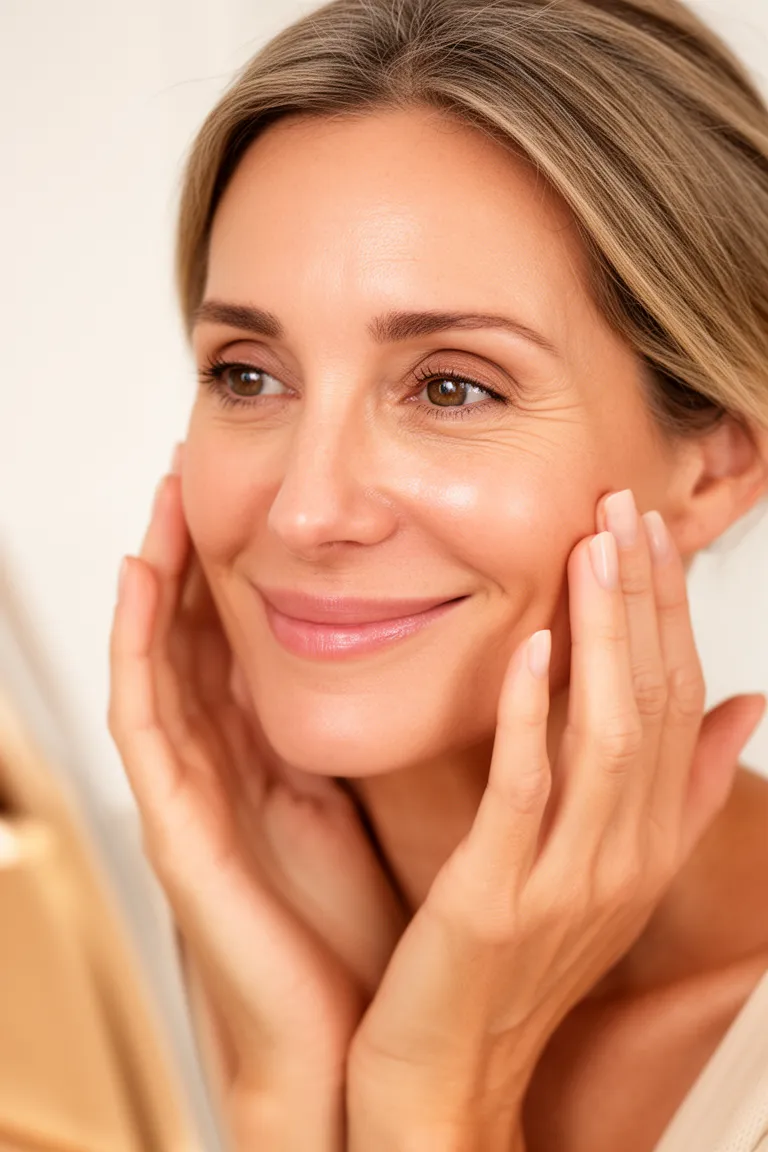
I was staring at my reflection in the harsh morning light, gently pulling at the skin on my cheek. It felt… different. Not just a fine line or a bit of dryness, but thinner, like a piece of delicate silk that had lost its weave. A slow, sinking feeling settled in my stomach. I’d done everything right—or so I thought. I’d been a sunscreen devotee since my late twenties, ate my vegetables, drank my water, and even managed regular workouts. Yet here I was at 46, facing a skin that seemed to be quietly deflating, no longer snapping back with the resilience I’d taken for granted. It felt profoundly unfair. I’d followed the rules, so why was my skin losing elasticity after 40 despite my healthy habits?
For months, this silent betrayal became my private obsession. I’d slather on the latest “firming” cream, its luxurious scent and hefty price tag promising a revolution. I’d layer serums with the precision of a chemist, chasing the elusive bounce. And every morning, I’d search for a change that never came. The gap between the marketing promises and my mirror’s reality widened into a canyon of frustration. I was spending a fortune and all my effort, yet my skin just wasn't getting firmer. I felt like I was speaking a language my skin no longer understood. That’s when I realized I was asking the wrong question. It wasn’t “What miracle product am I missing?” It was “What is my skin actually needing now, and what can I realistically expect?”
The Moment I Realized My Skin Was Losing Elasticity After 40
It wasn't a dramatic single event, but a series of small, undeniable shifts that chipped away at my confidence. The foundation that used to sit smoothly now seemed to settle into a texture I didn't recognize, like powder dusting over a fine mesh screen. When I smiled, the lines around my eyes stayed just a little longer, as if they were getting comfortable. But the real wake-up call was the tactile feeling—a lack of substance when I touched my face. It felt less like touching resilient fruit and more like touching a delicate, well-loved petal. This was my personal experience restoring skin elasticity after 40, and it started with this confusing, intimate sense of hollowness. I felt like I was moisturizing a sponge that had lost its core structure, pouring hydration into a vessel that couldn’t hold its shape.
I dove into research, desperate for answers, and found the cold, hard biology of it. My sunscreen and salads were brilliant shields, slowing down the attackers—UV rays, pollution, sugar—but they couldn't stop the internal clock. After 40, our bodies produce significantly less collagen and elastin, the very scaffolding of our skin. Every year, we lose about 1% of our collagen. It’s like a slow-motion demolition of the building’s steel frame, happening from the inside out. Furthermore, hormonal changes, especially for women, can accelerate the decline, leading to drier, thinner skin that shows laxity more easily. Estrogen, which helps keep skin plump and hydrated, takes a nosedive. I had to understand the crucial difference between dehydration (a temporary lack of water), thinning skin (a loss of structural layers), and true laxity (the weakening of the support network). My moisturizer was tackling the first, but my skin was struggling with the second and third. It was a sobering, yet strangely validating, realization. My healthy habits weren’t failing me; they were simply operating in a different, more limited theater than I had assumed.
Why My Expensive Firming Creams Did Almost Nothing
Armed with a new understanding, I looked at my graveyard of expensive jars with fresh eyes and a pang of regret. I had been conflating hydration with restoration. A good moisturizer, packed with humectants like hyaluronic acid and barrier-repairing ceramides, is a masterpiece at temporarily plumping the surface. It draws water in, making skin look smoother and fuller—for a few hours. It’s like spritzing a slightly wilted flower. It perks up, but the stem is still weak. But it cannot physically rebuild collagen or lift sagging skin. I was mistaking a temporary surface effect for genuine structural change, getting excited by a morning’s plumpness that faded by afternoon.
Then there were the actives: retinoids and peptides. The evidence for retinoids (like retinol) stimulating collagen production is strong, but the effect is modest and gradual—it’s a long-term renovation project, not a weekend facelift. Peptides can send signals to support skin health, but they aren’t magic building blocks you can just slap on. My mistake was using them aggressively, often layering a retinol serum, a peptide cream, and an exfoliating acid all in one night, driven by a “more is more” desperation. This cocktail compromised my skin barrier and led to irritation, redness, and dryness that actually undermined any potential benefit. Inflammation breaks down collagen. I was, in my frantic effort to rebuild, accidentally tearing more down. I was asking these creams to perform architectural miracles they were never designed for, which is why I felt like I was trying everything to improve skin elasticity after 40 with zero payoff. The question, "are firming creams worth it for skin elasticity after 40?" started to answer itself: only if you understand their true, limited job description.
The Simple, Boring Truth I Was Overlooking: The Skin Barrier
In my quest for a complex, high-tech solution, I had completely neglected the most fundamental piece: my skin barrier. Think of it like the exterior wall of a beautifully crafted house. I was trying to hang new pictures (add collagen) and install fancy new fixtures (use actives) on a wall that was cracked, peeling, and letting in drafts. No wonder nothing stuck. All my product-hopping, aggressive exfoliation, and frantic layering had likely made my skin more vulnerable, thinner, and less able to benefit from the good ingredients I was using. My skin was in a constant state of low-grade alarm, and you can’t build something strong on a foundation of stress.
Protecting and repairing the skin barrier became my non-negotiable first step. This didn’t mean buying another “barrier repair” cream and adding it to the pile. It meant a paradigm shift. It meant gentle cleansing (sometimes just with lukewarm water), consistent use of a simple, effective moisturizer with the right lipids, and unwavering sunscreen commitment—not as an anti-aging tactic, but as a fundamental, daily act of barrier defense against the world’s biggest aggressor. It felt almost too simple, too basic. Where was the exciting serum? The transformative cream? But this boring foundation was the crucial piece every glossy article and product description had glossed over in the race to sell me a “transformation.” I had to heal the wall before I could even think about redecorating.
The Routine I Built After Retinol and Random Serums Failed Me
I stripped everything back. My bathroom shelf, once a crowded apothecary, now held only a handful of bottles. My new mantra was “gentle, consistent, and protective.” My morning routine became a calm, three-step ritual that took less than five minutes: a lukewarm water rinse or the mildest cream cleanser if I’d used a treatment the night before, a moisturizer with ceramides and fatty acids, and my holy-grail broad-spectrum SPF 50. That’s it. Sometimes, on days my skin felt robust and calm, I’d add a vitamin C serum for antioxidant protection before my moisturizer, but I learned to listen to my skin’s needs day-by-day, not follow a rigid script.
The real shift came at night. Instead of bombarding my skin, I learned to introduce a retinoid with the respect and patience it demanded. I started with the lowest concentration I could find, using it just one night a week, literally “sandwiched” between layers of my barrier-repair moisturizer—a thin layer of moisturizer first, then the retinoid, then more moisturizer on top. This buffered the effect and minimized irritation. On the other six nights, I focused solely on moisture and repair: cleanse, a hydrating toner if I felt like it, and a generous layer of my moisturizer. If my skin felt the slightest bit sensitive or tight, I skipped the active entirely. I banished physical scrubs and harsh acids from my cabinet. This wasn’t a war on my skin; it was a peace treaty. I was finally working with my skin’s biology, not against it in a costly, frustrating battle.
why my anti aging skincare routine isn’t working
How Different Approaches Compare: A Realistic Roadmap
When I was lost in the jungle of options, what I craved was a map. Not a map to a mythical fountain of youth, but a realistic guide to the different paths I could take, based on my goals and commitment. Looking back, here’s how I’d break it down.
| Approach | Best For | Realistic Timeline for Visible Change | Key Consideration |
|---|---|---|---|
| Barrier-First Basics | Anyone with irritated, sensitive, or reactive skin; the essential starting point. | 2–4 weeks for improved comfort, reduced redness, and a healthier glow. | This is non-negotiable foundation. Skipping this to chase actives often backfires. |
| Basics + One Evidence-Based Active (e.g., Retinoid) | Those ready for long-term collagen support after establishing a stable barrier. | 6–12 weeks for subtle textural improvement; 3–6 months for modest firmness benefits. | Patience and consistency are everything. Results are gradual and cumulative. |
| Topical Routine + Professional In-Office Treatments | Addressing significant laxity or seeking more dramatic lifting than topicals can provide. | Varies by treatment (e.g., radiofrequency, microneedling). May require multiple sessions with weeks between. | Topicals maintain and enhance results; procedures do the heavy lifting. A significant investment. |
| Constantly Switching "Miracle" Products | No one. This was my frustrated, expensive mistake. | Endless cycle of hope and disappointment; no time for any one ingredient to work. | This pathway leads to wasted money, a compromised barrier, and burnout. Avoid it. |
This table helped me see my journey not as a failure, but as a progression. I had to start at the top and earn my way down, not leap to the bottom with unrealistic hopes.
Scientific Evidence
How Long It Really Takes to See Firmer-Looking Skin
This was the hardest lesson in patience, and it’s where most marketing preys on our desperation. I had to completely reset my expectations fed by “14-day transformation” campaigns. Here’s the reality I wish I’d known: improved hydration and a healthier barrier can make your skin look plumper, smoother, and more radiant within days or weeks. That “glow” is real and relatively quick—it’s the flower perking up after water. But collagen-related changes? That’s a marathon run at a slow, steady pace. Most dermatologists agree it takes a minimum of three to six months of consistent retinoid use to even begin to see subtle improvements in firmness and fine lines. We’re talking about convincing your skin’s fibroblasts to get back to work at a job they’ve been slowly retiring from for years. Effects of Oral Collagen for Skin Anti-Aging: A Systematic Review and Meta-Analysis.
I learned to judge progress not by dramatic before-and-after photos (which are often lit, angled, or filtered to sell), but by subtle, tangible signs: my skin felt more comfortable wearing makeup, it was less reactive to wind or stress, it had a more even texture when I ran my fingers over my cheeks. The “bounce” returned slowly, not from a single product, but from the cumulative effect of a protected, well-supported, and calmly functioning environment. I also had to make a crucial, peace-bringing peace with the fact that significant lifting of sagging skin along the jawline or cheeks is beyond the reach of even the best topical products. For that, procedures like microneedling, radiofrequency, or laser treatments exist—and knowing that helped me allocate my skincare budget and hopes more realistically. It answered my silent question: how long does it take to improve skin elasticity after 40 with topicals? Long enough that you need to fall in love with the process, not just the promise.
What I Would Do Differently If I Could Start Again
If I could go back and talk to my frustrated, product-clutching self in the harsh bathroom light, I’d hand her a simple list and a hug. First, I’d tell her to prioritize daily broad-spectrum SPF above all else—it’s not just one step, it’s the entire game. Protecting existing collagen is infinitely easier than trying to rebuild it under ongoing attack. Second, I’d insist on a gentle, consistent moisturizing routine to safeguard the barrier before she even thought about anti-aging. Health before heroics. Third, I’d advise her to pick one evidence-based active (like a retinoid or a stable peptide serum), research it thoroughly, and introduce it with glacial slowness, treating her skin’s response as the ultimate guide. Consistency with a simple routine beats a chaotic rotation of “miracle” products every single time.
how to fix fine lines around eyes when I already eat healthy and sleep well
I’d also tell her to see a dermatologist or a trusted, licensed aesthetician sooner. Not for a hard sell on procedures, but for an honest, professional assessment. A pro can look at your skin type, your specific pattern of laxity, your lifestyle, and help you create a truly personalized plan. They can recommend prescription-strength options like tretinoin if appropriate, and most importantly, they can set realistic goals. That one consultation would have saved me thousands of dollars and months of confusion, giving me a compass when I felt utterly lost. My journey to improve skin firmness after 40 naturally and realistically wasn’t about finding a secret weapon; it was about abandoning the battle mentality and embracing a long-term, nurturing strategy of support.
The Emotional Shift: From Fighting Aging to Nurturing Skin
The most profound change, the one that finally brought me peace, wasn’t in my mirror, but in my mindset. I stopped seeing my skin as a problem to be fixed, a traitor to be conquered, and started viewing it as a living, breathing organ to be cared for—the same way I cared for my heart by exercising or my gut by eating well. The goal shifted from the impossible “restoring my 30-year-old skin” to the empowering “having the healthiest, most resilient skin possible at 46.” This permission to have realistic expectations was liberating. The pressure lifted. My routine transformed from a desperate, twice-daily attempt to reverse time into a mindful act of self-care. It became my three minutes of calm in the morning, my signal to my body that I was listening.
This emotional acceptance was the final, missing piece in the puzzle. It allowed me to appreciate the improvements for what they were—a healthier complexion, better hydration, less reactivity, and perhaps a slight, hard-won improvement in firmness—without resenting my skin for its natural, beautiful evolution. The quest to restore skin elasticity after 40 when creams are not working led me to a much better, kinder question: how can I best support my skin’s health and function today? And that’s a question with a satisfying, sustainable answer.
Frequently Asked Questions

Q: How long does it take to see real improvement in skin elasticity after 40? A: It’s crucial to separate hydration from collagen repair. Better hydration and skin barrier health can make skin look plumper and smoother within a few weeks—this is the “quick win” that keeps you motivated. However, stimulating collagen production with ingredients like retinoids is a slow, biological process; most people need to use them consistently for 3 to 6 months to see subtle changes in firmness and fine lines. Think in seasons, not weeks. Significant lifting of sagging skin typically requires in-office treatments.
Q: Does retinol really help restore skin elasticity after 40? A: Yes, but with critical, realistic caveats. Retinol and other retinoids are among the most well-researched topical ingredients for stimulating collagen production. They can improve skin texture, firmness, and fine lines over time. However, the effect is gradual and modest—it’s a percentage improvement, not a total reversal. It won’t “restore” elasticity to a youthful level, but it can provide a measurable, worthwhile improvement when used consistently and correctly, and always, always paired with sunscreen to protect the new collagen you’re working so hard to build.
Q: Am I wasting money on products for skin elasticity after 40? A: Not if you spend wisely and shift your mindset. Money is absolutely wasted on expensive “miracle” creams that make dramatic lifting claims or on constantly switching products every month. Your money is well-invested in a high-quality, broad-spectrum sunscreen, a good barrier-supporting moisturizer with ceramides, and one well-formulated, stable active (like a retinoid or peptide serum). Consistency with these basics for 6+ months is far more valuable than a cabinet full of unproven, aggressively marketed potions.
Q: What should I look for in products if I want to improve skin firmness? A: Focus on formulas that support skin health first—this is the foundation everything else rests on. Look for moisturizers with barrier-repair ingredients like ceramides, fatty acids, and cholesterol. For actives, seek out retinoids (retinol, retinaldehyde) or peptide complexes, but ensure they’re from a reputable brand in stable, opaque packaging (many ingredients degrade in light/air). Remember, the most important “ingredient” is a formulation that doesn’t irritate your skin, as chronic inflammation is one of the biggest collagen destroyers.
Q: Why is my skin losing elasticity after 40 despite eating healthy and wearing sunscreen? A: Because intrinsic aging is a powerful, natural, and universal process. Sunscreen and diet are phenomenal for preventing accelerated aging caused by sun damage and inflammation (what’s called “extrinsic” aging), but they cannot stop the biological decline in collagen and elastin production that comes with time and hormonal shifts. Think of them as a brilliant, strong shield that slows the process dramatically—which is why your skin is likely in much better shape than it would be without them—but not a button that reverses the internal clock. Your healthy habits are still working heroically; they’re operating within the realm of biology, not magic.
firming skin treatment for women over 40
📌 Love this guide? Save it on Pinterest!
Pin Skin Elasticity After 40: Why Healthy Habits Aren't Enough ( to your board so you can come back to it later.

