
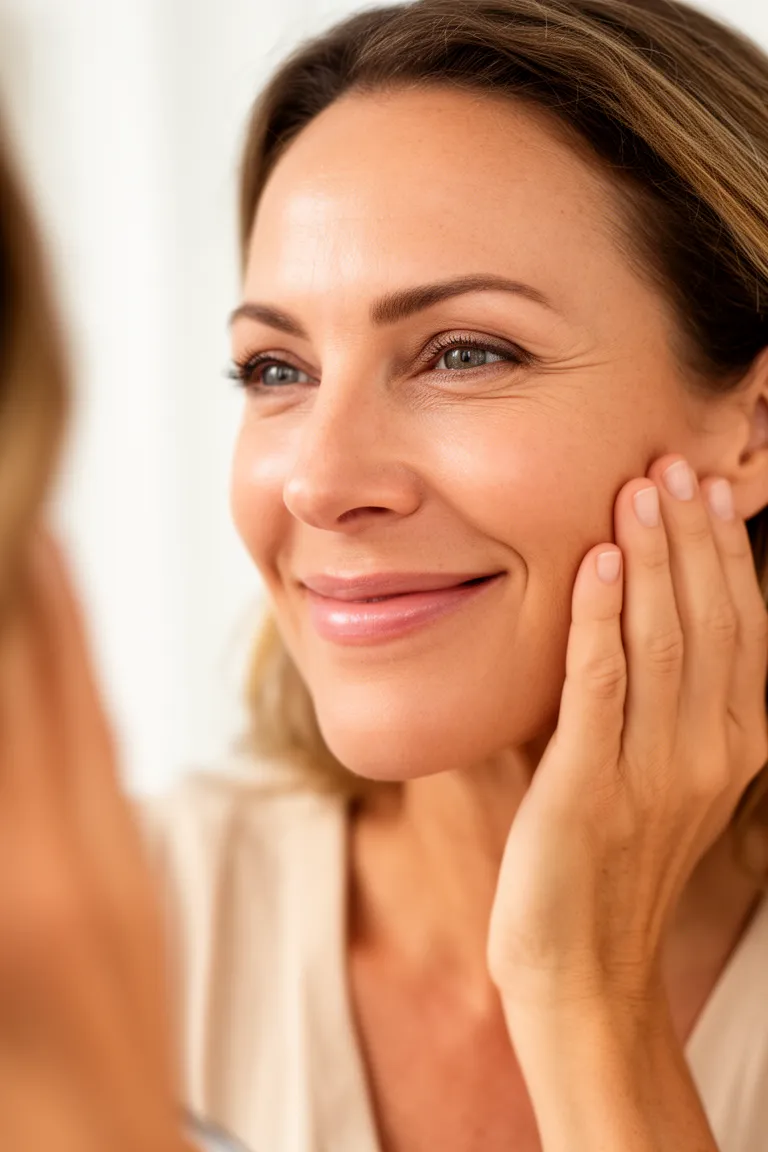
I did everything right. I’ve been a diligent SPF wearer since my late twenties, I drink water like it’s my job, my diet is full of leafy greens and lean protein, and I haven’t missed a yoga class in years. So, when I started noticing my skin looking thinner, less resilient, and just… vaguely deflated in my mid-forties, I felt a deep sense of unfairness. I’d followed the rules. I’d avoided the sunburns of my youth. Where was my reward?
The moment it truly hit me was on a Tuesday morning, leaning into a well-lit bathroom mirror after applying moisturizer. The skin along my jawline seemed to linger for a second longer after I pressed it, losing that immediate snap-back. It wasn’t about wrinkles; it was a subtle loss of substance, a quiet retreat of firmness that no amount of hydration seemed to touch. I’d invested in expensive “firming” creams and collagen powders promising rejuvenation, but the results were so faint I wondered if I was imagining them. The frustration was real. I wasn’t chasing a time machine; I just wanted my healthy efforts reflected in my skin’s resilience. That’s when my journey to understand how to restore skin elasticity after 40 truly began, and it led me away from miracle cures and toward a more honest, layered approach.
The Morning I Realized My Healthy Routine Wasn’t Making My Skin Firmer
That Tuesday morning was my turning point. I looked at my reflection and finally admitted that my diligent, healthy habits weren’t preventing this particular change. I felt a mix of betrayal and curiosity. Why was my skin, the organ I so carefully protected, starting to feel like delicate paper instead of resilient fabric? This is the frustrating gap so many of us hit: doing all the “right” things for general health and still watching skin elasticity quietly diminish. It’s a different beast from dryness or fine lines. You can hydrate a raisin and it plumps up, but it’s still a raisin—its structure has changed. I needed to understand that difference.
Why healthy habits cannot fully prevent age-related collagen and elastin loss
My first lesson was humbling. No matter how clean I ate or how much water I drank, I couldn’t stop the biological clock inside my skin cells. Starting in our mid-twenties, our bodies produce about 1% less collagen each year. Elastin, the protein that gives skin its snap-back quality, also becomes more fragile. My healthy lifestyle was absolutely slowing the process and protecting my overall health, but it wasn’t a forcefield. It was mitigating damage, not halting the intrinsic aging program. This was a crucial reframe: my routine wasn’t failing; it was doing its job of support, but it couldn’t single-handedly rebuild what time was naturally depleting. This is the core of the frustration for anyone wondering why their skin elasticity after 40 even though I eat healthy and exercise isn't what they expected. You're not doing it wrong. Biology is just a powerful force.
How laxity differs from dehydration, fine lines, and volume loss
I used to lump all “aging” skin concerns together. But laxity—that loss of firmness and elasticity—is its own issue. Dehydration is a lack of water, fixable with humectants. Fine lines are often from repeated movement and sun damage. Volume loss is fat pads shifting or diminishing. Laxity is about the structural scaffolding (collagen and elastin) weakening. You can have plump, hydrated skin that still lacks firmness. Realizing this helped me stop blaming my moisturizer and start looking for solutions that actually addressed the scaffolding. It explained why I could slather on the richest cream and still feel like my skin lacked its former "bounce."
What I Learned About Collagen, Elastin, and Skin Elasticity After 40
My deep dive began here. I learned that collagen is the sturdy mattress of our skin, providing structure and plumpness. Elastin is the spring system, allowing skin to stretch and recoil. After 40, it’s not just that we have less of these proteins; the quality deteriorates. Existing collagen fibers can become cross-linked and stiff, and elastin fibers can simply wear out from decades of facial expressions and gravity. Furthermore, the enzymes that break down collagen become more active. It’s a perfect storm of less production and more degradation.
Hydration and temporary plumping versus structural collagen support
This was my biggest “aha” moment, and it explains why so many of us feel stuck. A hyaluronic acid serum can pull water into the skin, making it look plumper and smoother—temporarily. A good moisturizer with ceramides can strengthen the skin barrier, preventing water loss and making skin look healthier. But these are surface-level improvements. They make the “house” look well-maintained, but they aren’t repairing the foundational beams that are slowly weakening. This is why I felt my anti-aging skincare routine wasn't improving skin firmness in a lasting way. I was excelling at maintenance but hadn’t yet started the renovation. I was treating the symptom (dryness) but not the cause (structural loss).
The Routine I Kept—and the Products I Stopped Expecting to Perform Miracles
I didn’t throw out my entire cabinet. Instead, I became savvier about what each product could realistically do. I stopped expecting my $200 firming cream to perform a structural overhaul and started seeing it as a supportive player in a much bigger game. My approach became about building a team, not finding a lone superstar.
Broad-spectrum SPF 30 or higher and practical reapplication
This became my non-negotiable religion. UV rays are the single biggest accelerator of collagen and elastin breakdown. Every bit of progress I could make with other products could be undone by sun exposure. I learned that “broad-spectrum” was key to protect against both UVA (aging) and UVB (burning) rays. I kept one by my front door and one in my bag. Reapplication, especially if I was outside, became a habit, not an afterthought. I do everything right but my skin still looks dull. It’s the most powerful preventative and protective tool you have. It’s the foundation upon which everything else is built.
Gentle cleansing, ceramides, glycerin, and hyaluronic acid
I traded stripping cleansers for gentle, creamy ones. A happy skin barrier is a receptive skin barrier. I sought out moisturizers with barrier-supporting ingredients like ceramides and fatty acids, and humectants like glycerin and hyaluronic acid. Their job was to keep my skin resilient, calm, and optimally hydrated so that any active ingredients I used for firmness could work effectively. This step alone made my skin look and feel better, even before tackling elasticity directly. It’s the daily act of kindness your skin needs.
Gradual retinoid use, irritation management, and pregnancy precautions
Here’s where I finally addressed the scaffolding. Retinoids (vitamin A derivatives) are one of the few topical ingredients with decades of research showing they can actually stimulate collagen production. But they are a marathon, not a sprint. I started with a low concentration, using it just twice a week, and always on dry skin after cleansing. I paired it with my barrier-supporting moisturizer to manage the inevitable dryness and flaking. The key was consistency and patience. After six months of gradual increase, I noticed a real difference in texture and firmness—not a miracle, but a tangible improvement. It’s a commitment, but for me, retinoids are worth it for skin elasticity after 40. They require you to listen to your skin and go slow, which in itself is a valuable lesson.
Why My Collagen Experiment Didn’t Give Me Overnight Results
Like many, I jumped on the oral collagen supplement bandwagon. I mixed powders into my coffee, hoping for a quick fix. Months went by with only the faintest hint of improvement in my nail strength. I was ready to write it off as hype until I dug into the science and adjusted my expectations completely.
What oral collagen studies suggest about elasticity and hydration
The evidence is promising but nuanced. Several studies show that specific types of hydrolyzed collagen peptides, taken consistently over 8-12 weeks, can improve skin hydration, elasticity, and collagen density. The key words are “specific,” “consistent,” and “8-12 weeks.” It’s not an overnight phenomenon. The theory is that these peptides may act as building blocks or signal the body to produce more of its own collagen. I adjusted my expectations. I now see supplementation as a potential long-term support system, not a magic bullet. Does collagen help restore skin elasticity after 40? It might contribute meaningfully as part of a holistic plan, but it won’t work in isolation or immediately. It’s a nourishing supplement, not a prescription.
Choosing products by dose, testing, allergens, and third-party verification
I learned to be a label detective. I looked for products that stated the dose (often 2.5-10 grams per serving), the type of collagen (Types I & III are common for skin), and third-party testing for purity. I also had to accept that, for some of us, the results are subtle. It’s a tool in the toolbox, not the whole workshop. This journey taught me that my experience restoring skin elasticity after 40 would be a collection of small, consistent actions, not one grand gesture.
Mapping Your Path: A Realistic Look at Different Approaches
One of the most clarifying things for me was understanding that there isn't one "right" path. Your approach depends on your starting point, your goals, and what you're willing to commit to. I wish I had seen a simple breakdown like this earlier—it would have saved me from comparing my beginning to someone else's middle.
| Approach | Best For | Realistic Timeline for Noticeable Change | Key Consideration |
|---|---|---|---|
| The Foundational Guard | Starting fresh or focusing solely on prevention. Emphasizes SPF, gentle cleansing, and basic hydration. | 4-6 weeks for improved skin feel and health. | Essential for everyone, but won't reverse existing laxity. It's your baseline non-negotiable. |
| The At-Home Renovator | Those ready to consistently use actives (like retinoids) and supportive supplements to improve skin quality and mild laxity. | 3-6 months for measurable improvements in firmness and texture. | Requires patience and routine. Results are gradual but sustainable with ongoing use. |
| The Professional Partnership | Addressing more pronounced laxity that hasn't responded adequately to years of diligent at-home care. | Improvement seen over 3-6 months after a series of treatments, with final results maturing up to a year. | Involves significant cost, downtime, and requires a trusted, board-certified provider. Not a one-time fix. |
Scientific Evidence
When At-Home Care Wasn’t Enough: What Professional Treatments Can—and Can’t—Do
After a year of religious at-home care, I saw definite improvement in my skin’s texture, glow, and some firmness. But the more pronounced laxity along my jawline? That was stubborn. I had to face the fact that topicals have a limit. They can improve the quality of the skin you have and stimulate some new collagen, but they cannot significantly lift or tighten skin that has lost its structural integrity. This is when I truly understood that Functional integrity of aging skin, from cutaneous biology to anti-aging.... It’s like sending in a construction crew versus doing DIY repairs.
Expected improvement, treatment intervals, cost, and downtime
The dermatologist was brutally honest, which I appreciated. She said I could expect a noticeable but percentage-based improvement in firmness with a series of treatments—think 20-30%, not a return to my 30-year-old skin. Each session had a cost (significant) and downtime (redness, swelling for several days). It required a series, spaced months apart, and maintenance treatments yearly. This wasn’t a quick fix; it was an investment and a commitment. It forced me to define my “why” and set realistic expectations for treatments for lost skin elasticity after 40. This is the reality check most articles gloss over.
The Realistic Timeline: Learning Patience in a Quick-Fix World
This was my final, and perhaps hardest, lesson. Our culture promises 10-day transformations, but skin biology operates on a different clock. When I started using retinoids, I saw irritation within days, but firmness changes took 4-6 months. With collagen supplements, studies point to 3 months minimum. Professional treatments require even more patience, with final results appearing months after the last session. I had to shift my mindset from “fixing” a problem to “nurturing” an organ. How long does it take to improve skin elasticity after 40? Honestly, it takes months of consistent effort, and the journey is ongoing. The goal isn’t perfection; it’s the best, healthiest, most resilient skin for my age. This timeline is the silent truth behind every successful story.
Embracing the Journey, Not Just the Destination
Today, my approach is layered and free of frantic energy. My non-negotiables are daily broad-spectrum SPF, a gentle yet effective skincare routine with a retinoid, and internal nourishment. I consider collagen supplementation a supportive habit. And I’m saving for a professional treatment, now with clear, realistic goals. The frustration I felt that Tuesday morning has transformed into empowerment. I’m no longer wasting money on miracle promises or feeling betrayed by my body. Instead, I’m making informed choices that respect both the science of skin and the reality of my life after 40. The firmness has improved, yes, but more importantly, the anxiety around losing it has faded. I’m working with my skin, not against time. And that feels like the truest form of restoration.
Frequently Asked Questions
Q: How long does it really take to see results from things like retinoids or supplements? A: You need to arm yourself with patience. With topical retinoids, you might see initial irritation or peeling within a week, but meaningful improvements in firmness and texture typically take 4-6 months of consistent, gradual use. For oral collagen supplements, most clinical studies showing improvements in skin elasticity measure results after 8-12 weeks of daily use. This is a marathon, not a sprint. Mark your calendar for three months out, not three weeks.
Q: I eat very healthily and exercise. Is losing skin elasticity after 40 inevitable? A: Your healthy habits are incredibly valuable—they slow down the process, improve skin quality, and support overall collagen health. However, some degree of intrinsic, genetic aging is inevitable. Think of your diet and exercise as the best possible defense, minimizing the damage and keeping your skin’s “soil” fertile for other interventions like retinoids or professional treatments to work more effectively. You're laying the best groundwork possible.
Q: What’s the single most important product for restoring elasticity if I can only do one thing? A: Without a doubt, it’s a broad-spectrum sunscreen (SPF 30 or higher) worn every single day, rain or shine, indoors or out. UV radiation is the primary external factor that breaks down collagen and elastin. No amount of collagen cream or serum can counteract daily sun damage. Prevention is always more effective than correction. It’s the cornerstone.
Q: Are professional treatments worth the cost and downtime for someone who’s already tried firming creams? A: This is the personal calculation I faced. For significant laxity that hasn’t responded to years of diligent topical care—the feeling that I tried firming creams but my skin is still sagging after 40—professional treatments can offer a level of improvement that creams cannot. However, they are an investment, require recovery time, and offer a percentage of improvement, not a total reversal. A consultation with a board-certified dermatologist is essential to set realistic expectations for your specific situation.
Q: What should I look for in a collagen supplement if I decide to try one? A: Look for hydrolyzed collagen peptides (for better absorption), a clear dose per serving (typically 2.5g to 10g), and types I and III, which are associated with skin. Third-party testing seals (from organizations like NSF or USP) verify purity and that what’s on the label is in the bottle. Remember, it’s a long-term support supplement, not an instant fix. Think of it as daily nourishment, not a rescue.
📌 Love this guide? Save it on Pinterest!
Pin Restore Skin Elasticity After 40: My Honest Journey & What Works in 2026 to your board so you can come back to it later.

